
If you're searching for a Certified Sex Addiction Therapist in Utah, you're likely facing one of the most difficult moments of your life. Whether you're struggling with compulsive sexual behavior yourself or you're a partner devastated by betrayal, finding the right specialist matters more than you might realize.
This guide will help you understand what CSAT certification actually means, how to find qualified therapists in Utah, what questions to ask before your first appointment, and why choosing a specialist can make the difference between genuine recovery and years of frustration.
What Is a CSAT and Why Does It Matter?
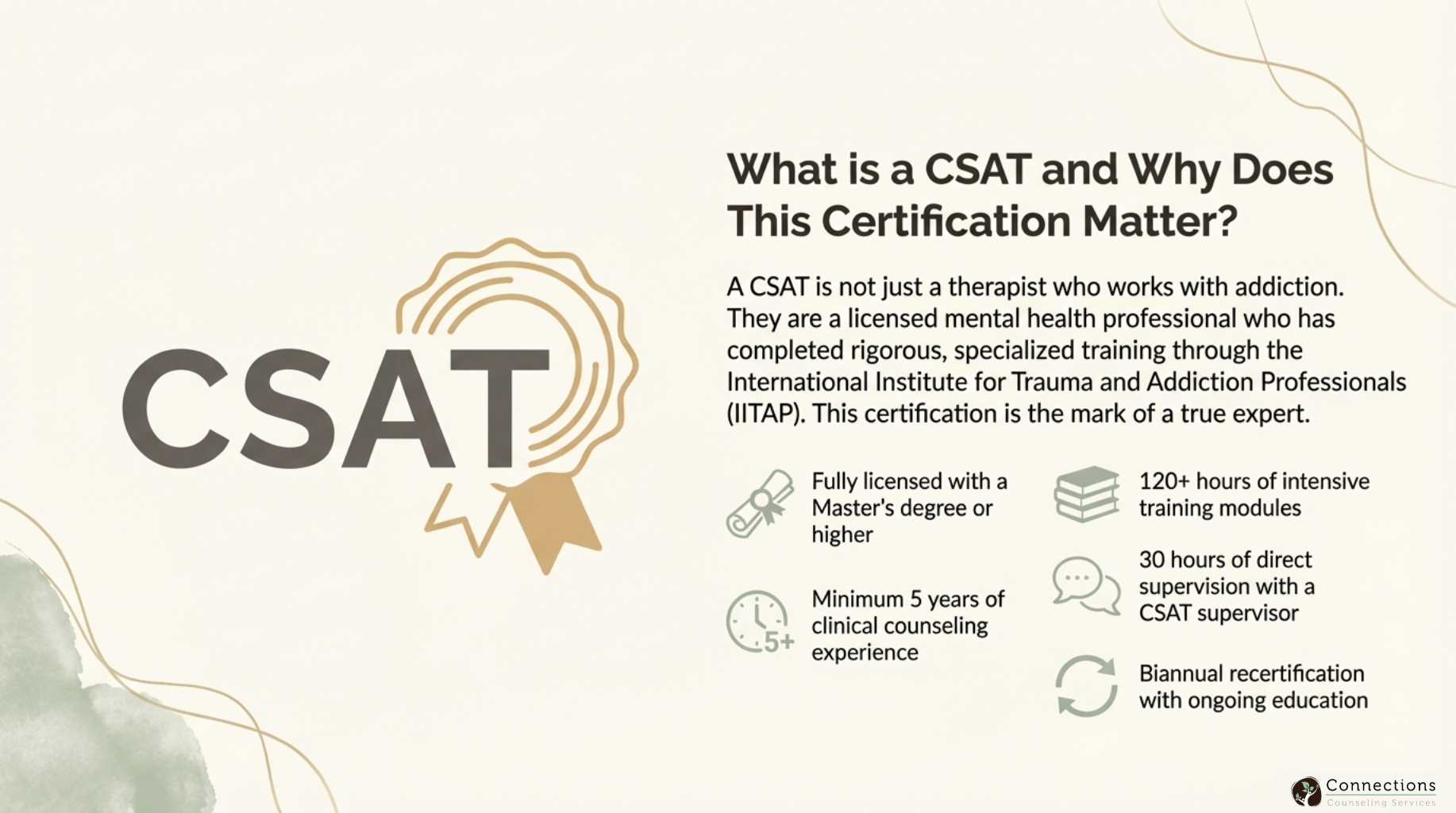
A CSAT (Certified Sex Addiction Therapist) is not just a therapist who works with addiction. They are licensed mental health professionals who have completed rigorous specialized training through the International Institute for Trauma and Addiction Professionals (IITAP).1 This certification represents a significant investment in expertise that general therapists simply do not have.
CSAT Certification Requirements
To earn and maintain CSAT certification, therapists must meet demanding standards:1
✓ Education: Master's degree or higher with full licensure
✓ Experience: Minimum 5 years of clinical counseling
✓ Specialized Training: 120+ hours focused on sexual addiction
✓ Supervision: 30 hours with a CSAT Supervisor
✓ Ongoing: Biannual recertification with continuing education
This level of training ensures that CSATs understand the neurobiological components of sexual addiction, the shame cycles that keep people trapped, the specific assessment tools needed for accurate diagnosis, and the evidence-based treatment protocols that actually work.
What Can Go Wrong Without a Specialist
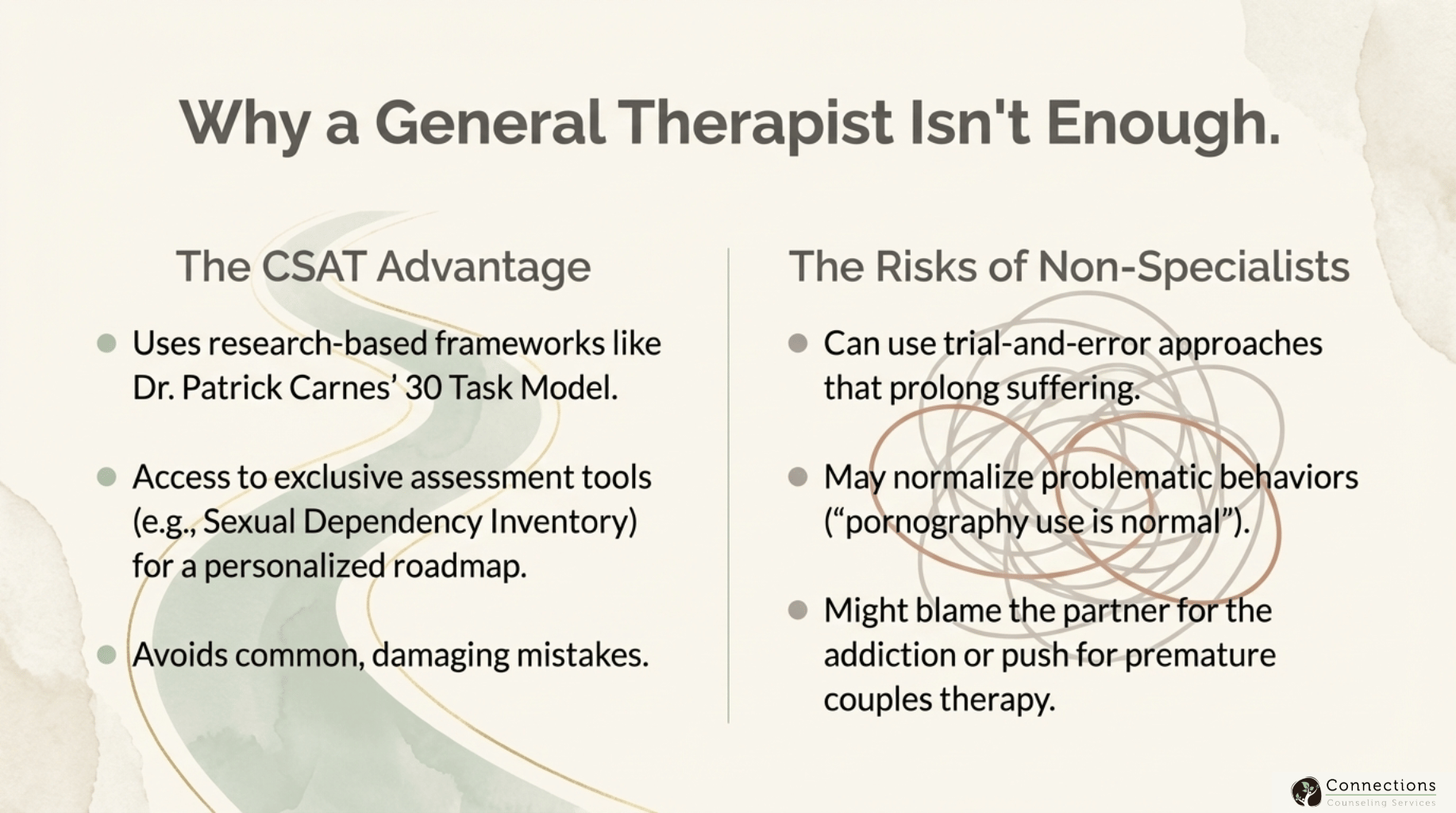
When someone struggling with sexual addiction or their partner sees a general therapist without specialized training, several harmful patterns can emerge:
Normalizing harmful behavior. A well-meaning therapist might tell someone that their pornography use is "normal" or "not a big deal" when it has actually escalated to the point of destroying their marriage and career.
Blaming the partner. Without understanding betrayal trauma, some therapists inadvertently suggest the partner contributed to the addiction or needs to be "less controlling" about boundaries.
Premature couples therapy. Jumping into couples work before the addicted partner has established sobriety and accountability often retraumatizes the betrayed partner and enables continued deception.
Stalled disclosure. Without structured therapeutic disclosure protocols, the truth comes out in painful fragments over months or years, compounding trauma with each new revelation.
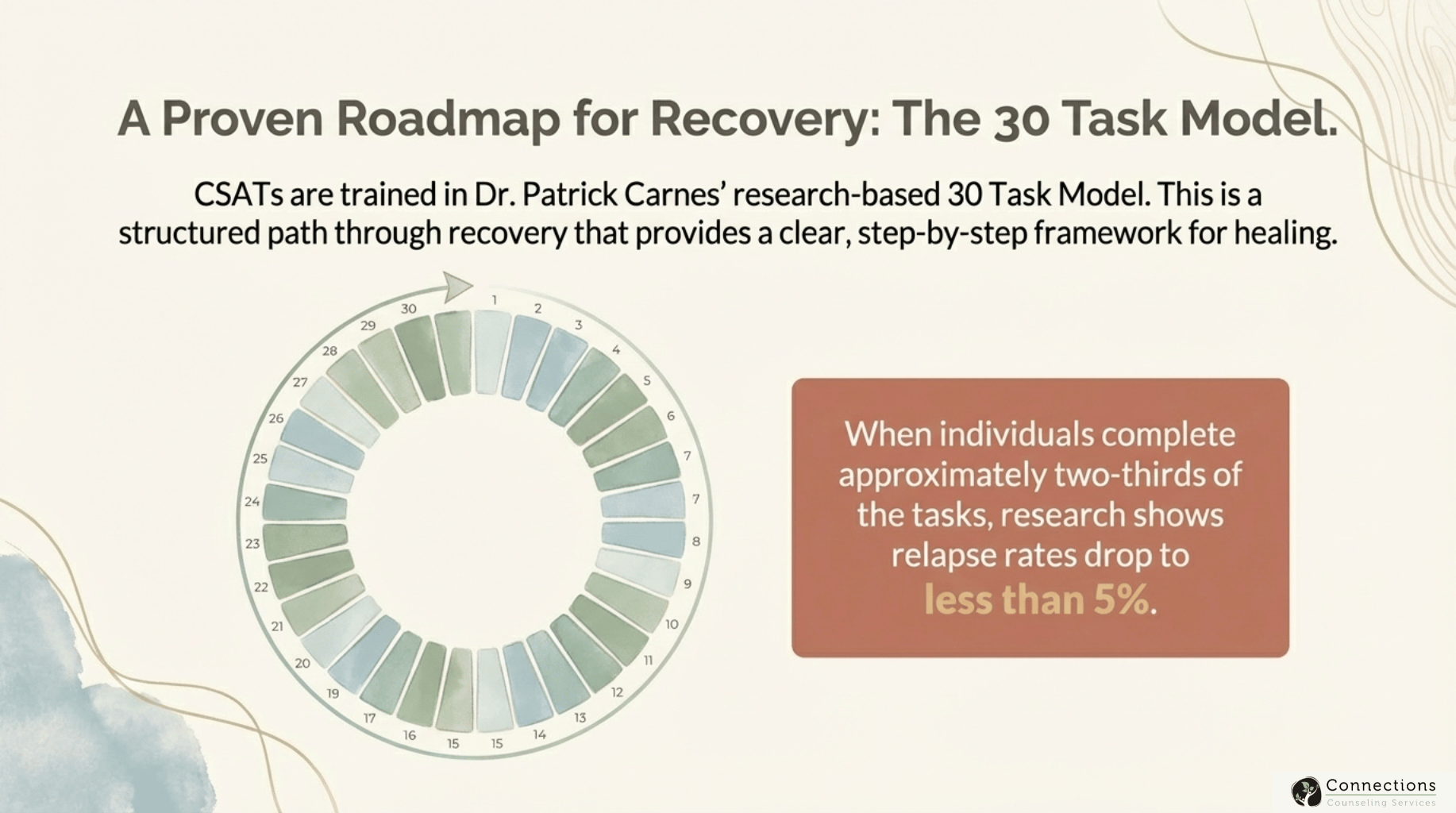
The Proven Roadmap: The 30 Task Model
CSATs are trained in Dr. Patrick Carnes' research-based 30 Task Model.2 This is a structured path through recovery that provides a clear, step-by-step framework for healing. It addresses everything from breaking through denial to rebuilding intimacy to creating a sustainable recovery lifestyle.
The research is compelling: When individuals complete approximately two-thirds of the tasks over a period of 2-3 years, relapse rates drop to less than 5%.2,3 This is dramatically better than outcomes from general therapy approaches.
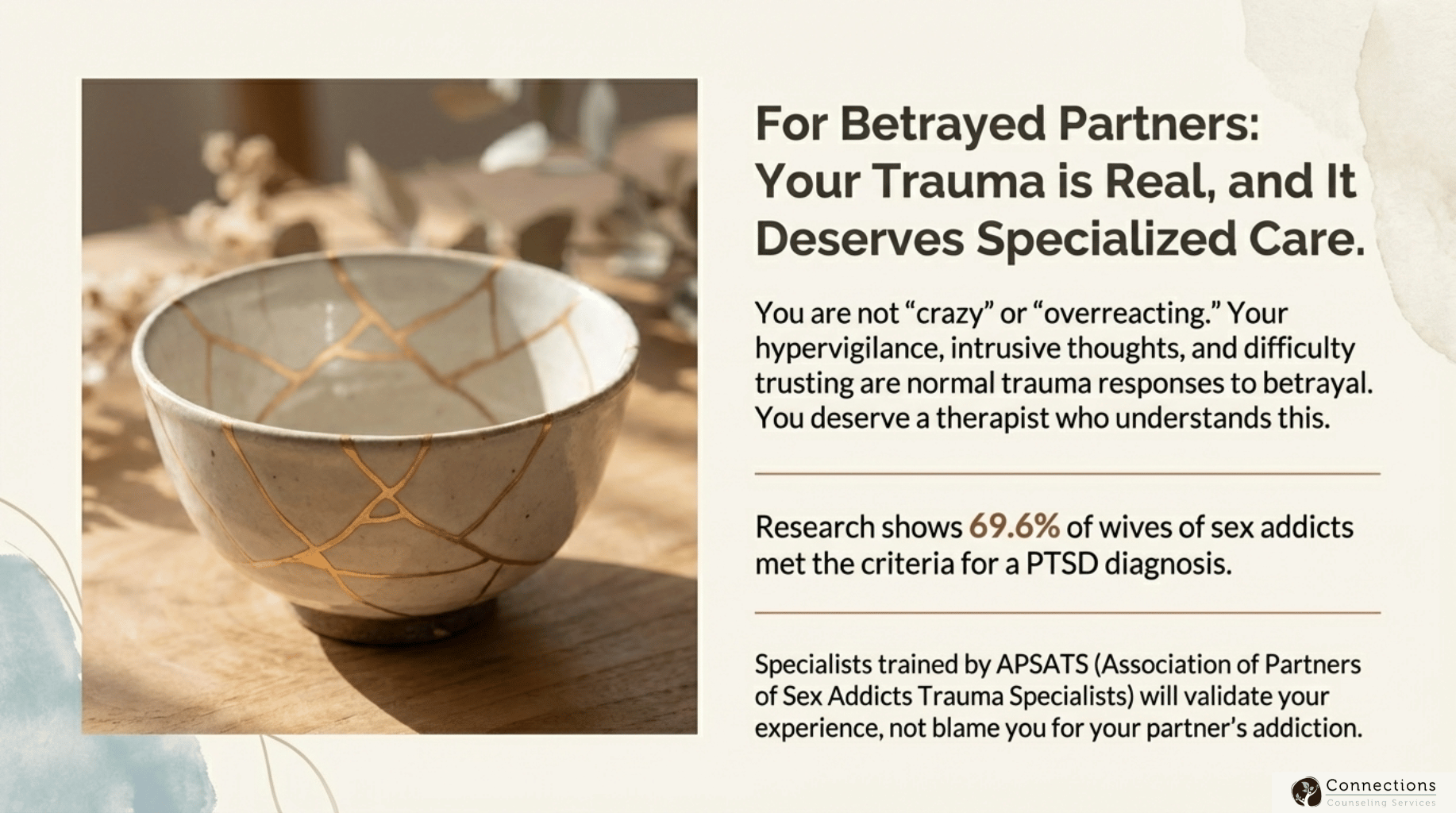
For Betrayed Partners: Your Trauma Is Real
If you are the partner of someone with sexual addiction, you need to know something important: you are not crazy or overreacting. Your hypervigilance, intrusive thoughts, and difficulty trusting are normal trauma responses to betrayal.
Research by Steffens and Rennie shows that 69.6% of wives of sex addicts met the criteria for a PTSD diagnosis.4 This is not relationship disappointment. It is trauma that deserves specialized care.
Specialists trained by APSATS (Association of Partners of Sex Addicts Trauma Specialists) and those holding CPTT (Certified Partner Trauma Therapist) credentials will validate your experience rather than blaming you for your partner's addiction.5 They understand that your healing requires its own dedicated process, separate from your partner's recovery work.
How to Find a CSAT in Utah
Use the Official Directories
IITAP Directory: The International Institute for Trauma and Addiction Professionals maintains a searchable directory at iitap.com. You can filter by location and certification level (CSAT or CSAT-S for supervisors).
APSATS Directory: If you are a betrayed partner seeking your own therapist, the Association of Partners of Sex Addicts Trauma Specialists directory at apsats.org lists specialists trained specifically in partner trauma, including those with CPTT certification.
Questions to Ask Before Your First Appointment
When you contact a potential therapist, consider asking:
→ Are you a Certified Sex Addiction Therapist (CSAT) through IITAP?
→ Do you have CPTT certification for working with betrayed partners?
→ How long have you been working specifically with sexual addiction?
→ What treatment model do you use?
→ Do you work with partners as well, and do you have separate therapists for each person?
→ What is your approach to therapeutic disclosure?
→ How do you coordinate care if my partner and I are both in treatment?
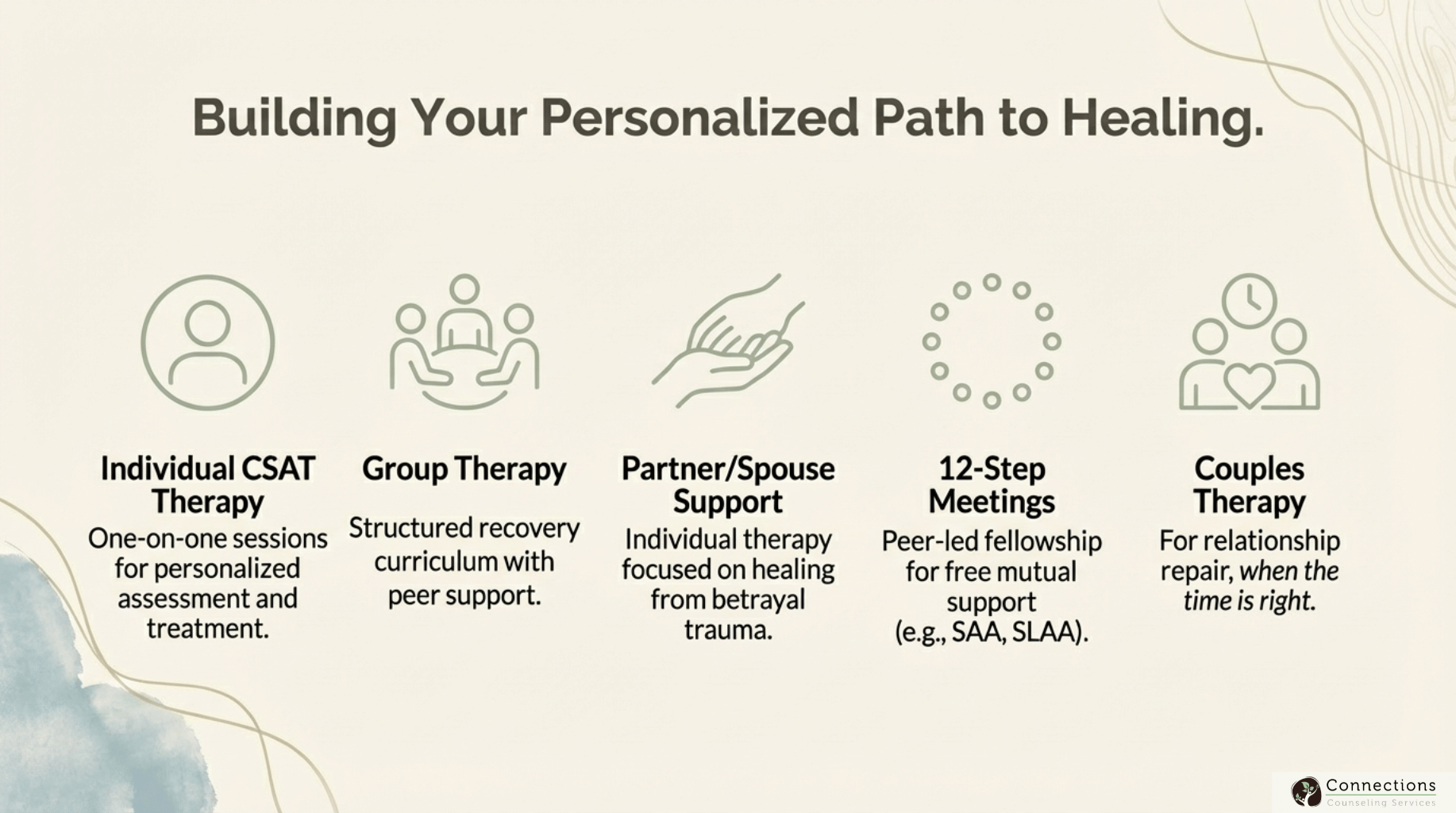
Understanding Your Treatment Options
Recovery from sexual addiction typically involves multiple components working together:
Individual CSAT Therapy: One-on-one sessions for personalized assessment and treatment using the 30 Task Model.3 This is the foundation of recovery.
Group Therapy: Structured recovery curriculum with peer support. There is something powerful about being in a room with others who truly understand what you are facing.
Partner/Spouse Support: Individual therapy with a CPTT-certified therapist focused specifically on healing from betrayal trauma. This is separate from your partner's recovery work.
12-Step Meetings: Peer-led fellowship programs like SAA (Sex Addicts Anonymous) or SLAA (Sex and Love Addicts Anonymous) provide free ongoing mutual support.
Couples Therapy: For relationship repair when the time is right. This should only begin after individual work has established safety and accountability.
Why Choose Connections Counseling Services
At Connections Counseling Services, our entire team is dedicated to this specialized work. We have multiple Certified Sex Addiction Therapists (CSATs) and Certified Partner Trauma Therapists (CPTTs) on staff who understand both the addict's recovery needs and the partner's trauma. We are here to guide you with expertise and compassion.
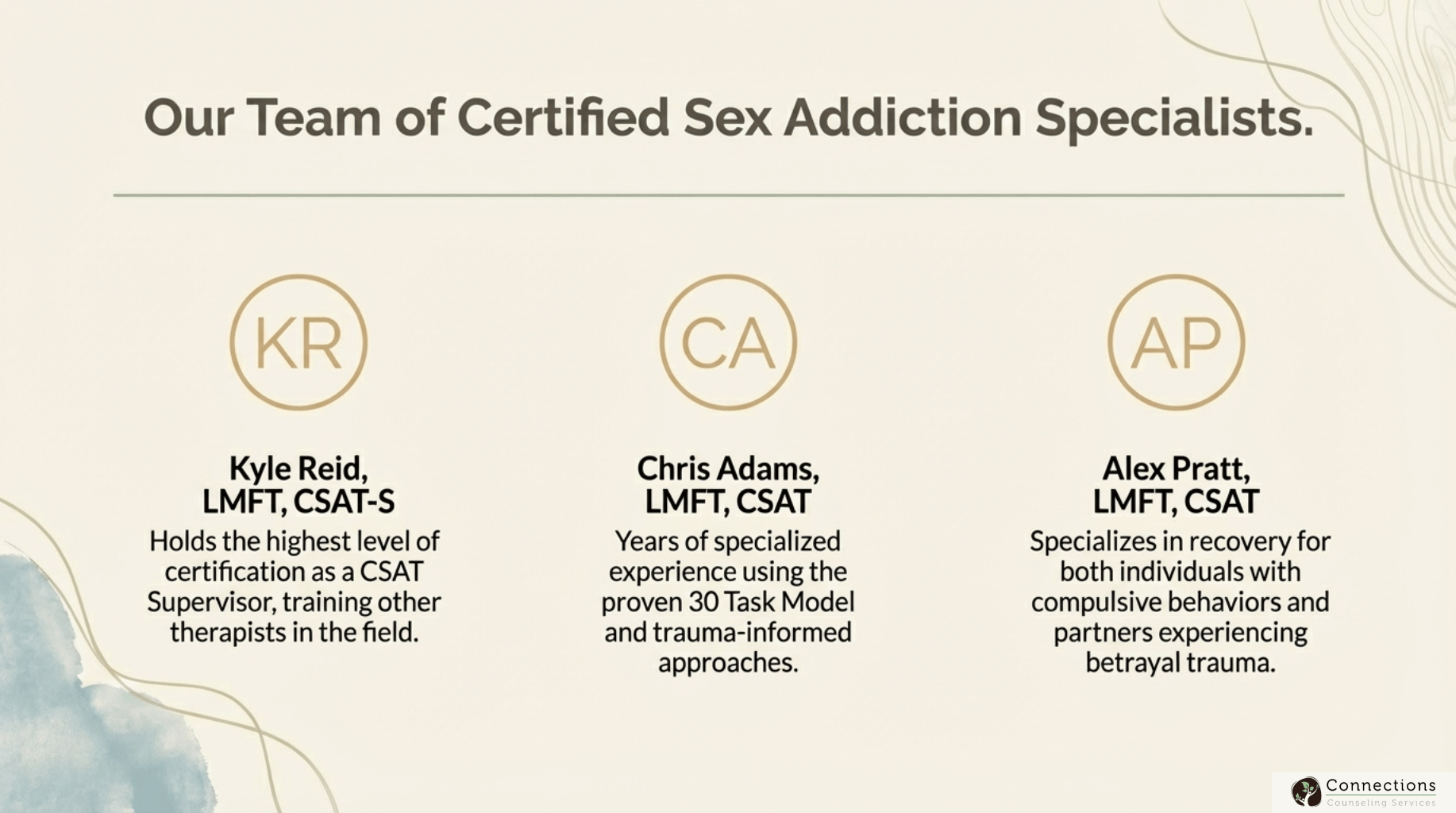
Our Team of Certified Sex Addiction Specialists
Kyle Reid, LMFT, CSAT-S
Kyle holds the highest level of certification as a CSAT Supervisor, meaning he trains other therapists in the field. His advanced expertise and years of clinical experience make him a leader in sexual addiction treatment in Utah.
Chris Adams, LMFT, CSAT
Chris brings years of specialized experience using the proven 30 Task Model and trauma-informed approaches. He works with both individuals struggling with compulsive sexual behavior and partners navigating betrayal trauma.
Alex Pratt, LMFT, CSAT
Alex specializes in recovery for both individuals with compulsive behaviors and partners experiencing betrayal trauma. His approach integrates evidence-based treatment with genuine compassion.
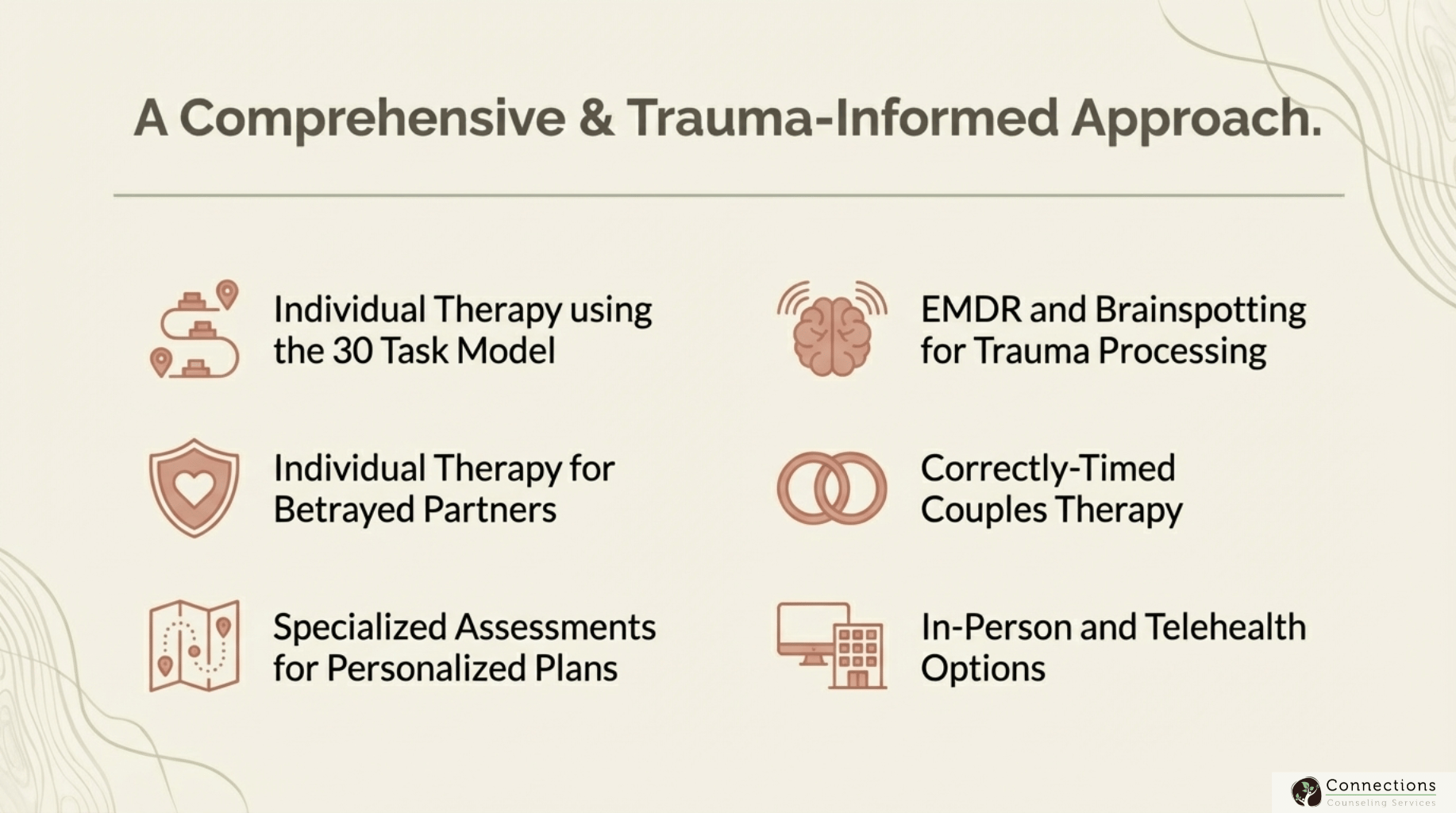
A Comprehensive and Trauma-Informed Approach
Our practice offers:
✓ Individual Therapy using the 30 Task Model
✓ Individual Therapy for Betrayed Partners (CPTT-trained therapists)
✓ EMDR and Brainspotting for trauma processing
✓ Correctly-Timed Couples Therapy
✓ Specialized Assessments for personalized plans
✓ In-Person and Telehealth Options
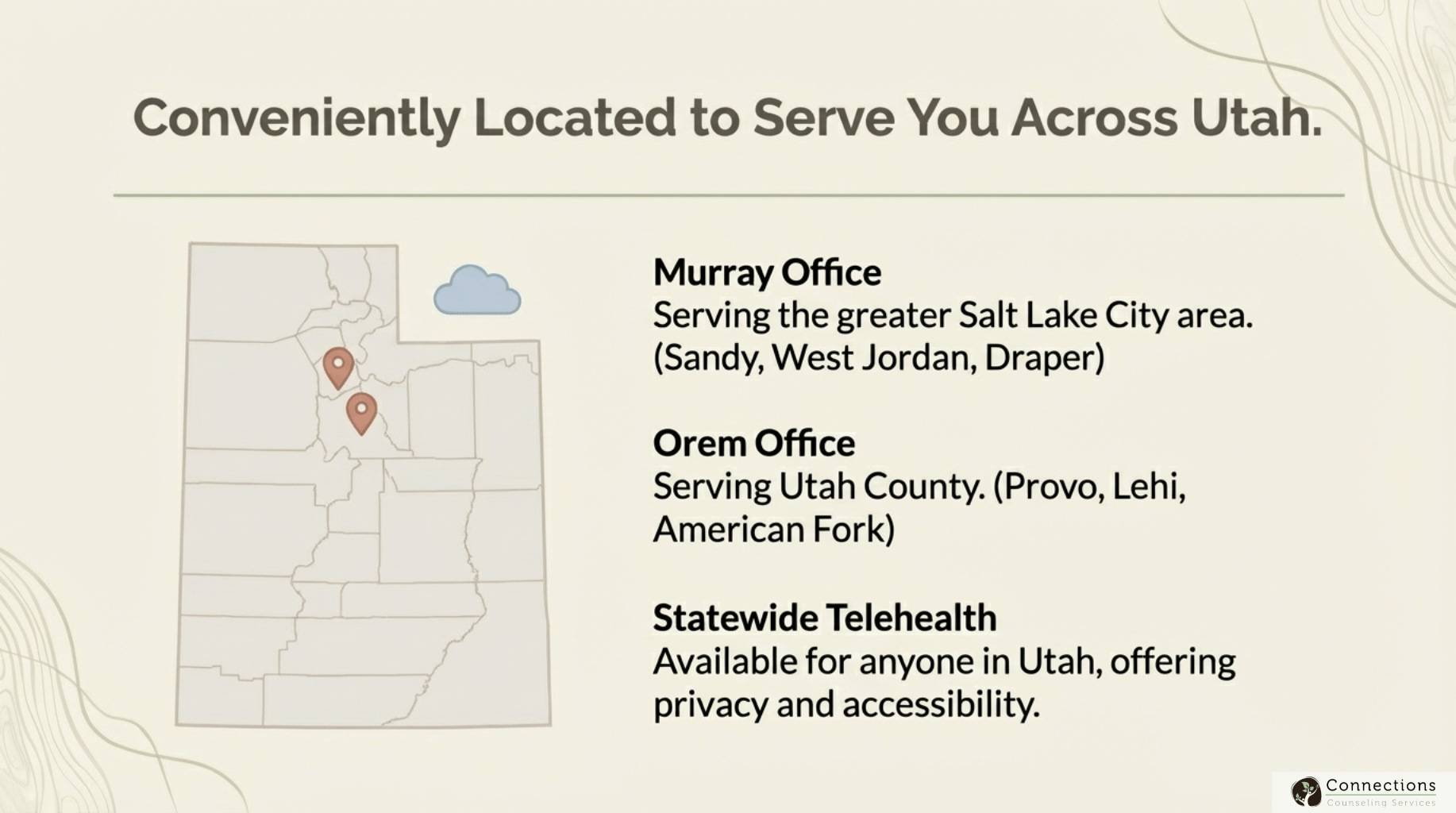
Conveniently Located to Serve You Across Utah
Murray Office: Serving the greater Salt Lake City area including Sandy, West Jordan, Draper, and surrounding communities.
Orem Office: Serving Utah County including Provo, Lehi, American Fork, and surrounding communities.
Statewide Telehealth: Available for anyone in Utah, offering privacy and accessibility for those who prefer remote sessions or live outside our office areas.
Frequently Asked Questions
Do I really need a CSAT?
If pornography or sexual behavior is causing problems in your life, relationships, or has led to betrayal trauma, a specialist is essential. General therapists lack the specific training to address the unique dynamics of sexual addiction and partner trauma.
How long does treatment take?
Recovery is a marathon, not a sprint. Most people work with a CSAT for 2-5 years as stability grows.2 The 30 Task Model provides structure, but everyone moves at their own pace.
What is the difference between CSAT and CPTT certification?
CSAT (Certified Sex Addiction Therapist) certification through IITAP focuses on treating individuals with compulsive sexual behavior. CPTT (Certified Partner Trauma Therapist) certification through APSATS specializes in treating betrayed partners experiencing trauma. Some therapists hold both certifications.
Does insurance cover this?
Many plans offer coverage for therapy services. We provide documentation for reimbursement and offer sliding scale fees for those who need financial flexibility.
Can I do therapy via telehealth?
Absolutely. Research shows telehealth therapy is just as effective as in-person sessions. It is a great option for privacy, convenience, and for clients throughout Utah who cannot easily reach our offices.
What if my partner refuses to get help?
You can still begin your own healing journey. Many partners start individual therapy with a CPTT-certified therapist to process their trauma regardless of what their spouse chooses to do. Your recovery does not depend on theirs.
Take the First Step on Your Journey
You have already taken the hardest step by searching for help. The shame you feel right now does not have to be permanent. Recovery is possible, and you do not have to do this alone.
Call: 801-272-3420
Text: 801-997-8760
Locations: Murray, UT and Orem, UT
Website: connectionscs.com
We offer both in-person and telehealth appointments throughout Utah.
References
1 International Institute for Trauma and Addiction Professionals. (n.d.). CSAT certification requirements. IITAP. https://iitap.com/
2 Carnes, P. J. (1991). Don't call it love: Recovery from sexual addiction. Bantam Books.
3 Carnes, P. J. (2001). Facing the shadow: Starting sexual and relationship recovery (2nd ed.). Gentle Path Press.
4 Steffens, B. A., & Rennie, R. L. (2006). The traumatic nature of disclosure for wives of sexual addicts. Sexual Addiction & Compulsivity, 13(2-3), 247-267. https://doi.org/10.1080/10720160600870802
5 Association of Partners of Sex Addicts Trauma Specialists. (n.d.). CPTT certification. APSATS. https://apsats.org
