
Parenting a young adult means trading control for influence. As children move into their twenties, directives that once worked start damaging the relationship, while curiosity, clear expectations, and respect for their autonomy preserve it. Connections Counseling offers individual sessions and parent groups on this transition in Orem, Murray, and online across Utah.
Why does parenting get harder when they grow up?
Most parents expect the hard part to be over by their child's twenties. Frequently it is not. The difficulty simply changes shape.
For eighteen years you had legitimate authority. You set the rules, you carried the consequences, and steering was part of the job. Then, over a fairly short stretch, that authority ends — but the caring does not, and neither does your view of what would be good for them.
What follows is the central problem of this stage: you can still see clearly what your child should do, and you no longer have any standing to make it happen. Parents who keep trying anyway tend to lose access to the relationship. Parents who go silent to avoid conflict often lose it too, in a quieter way.
There is a third option, and it is learnable.
Managing expectations — yours and theirs
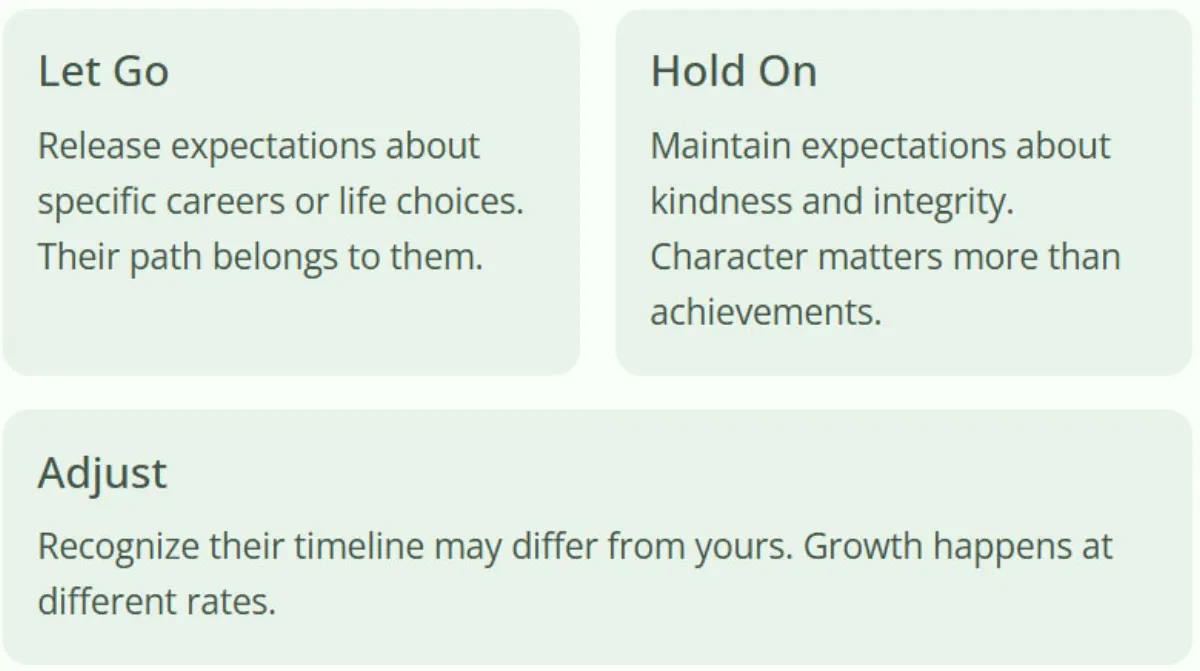
A good deal of the friction at this stage comes from an unexamined timeline in a parent's head. Graduated by twenty-two. Married by twenty-five. Career underway. Financially independent.
Some of that timeline is genuine wisdom. Some of it is simply your own life, or the life you wish you had had, projected onto someone whose circumstances are not yours. Disentangling the two is worth doing deliberately, because your adult child can feel the difference between a value you hold and a schedule you are enforcing — and they respond very differently to each.
It is worth noticing, too, that the ground has shifted. Housing costs, career paths, and the age of first marriage have all moved substantially in a generation. A young adult who seems behind against your timeline is frequently on time against their own.
Fostering their sense of purpose
Young adults who are struggling are often described as unmotivated. Much more commonly, they are unanchored — they have not yet found something that feels like theirs.
Purpose is not something you can hand over. But you can make its discovery more likely: by taking their interests seriously even when those interests are not the ones you would have chosen, by asking real questions instead of leading ones, and by resisting the urge to immediately assess whether the thing they care about can support a family.
The parent who says "tell me more about that" gets a great deal more access than the parent who says "and how would you make a living at it?" — even when the second question is a fair one and will eventually need asking.
Building the skills independence actually requires
Plenty of young adults leave home fully capable academically and quite unprepared practically. This is rarely their fault. Skills that are never handed over never get learned.
The ones that matter most tend to be unglamorous.
The teaching window is narrow and it is mostly already closing, so the approach that works now is different from instruction. Offer once, clearly. Let natural consequences do the teaching where the stakes are survivable. Resist rescuing from things that are merely uncomfortable — a late fee, an awkward phone call, a missed opportunity — because those are precisely the lessons that cost the least to learn.
- Managing money: a budget, what credit actually costs, what a bill left unpaid does over time.
- Handling their own logistics: appointments, paperwork, renewals, insurance.
- Repairing conflict rather than avoiding it or escalating it.
- Asking for help before a problem becomes an emergency.
- Tolerating discomfort without needing it fixed immediately.
Going from control to influence
This is the heart of it, and it is genuinely a trade. You give up the ability to direct, and what you receive in exchange is the ability to be heard — which, in the long run, is worth considerably more.
Influence is built out of a few things that are simple to describe and hard to practice.
Parents often hear this as passivity. It is not. It is the recognition that your leverage is no longer positional — it comes from being someone whose opinion your adult child actually wants.
- Being safe to talk to. If bad news reliably produces a lecture, you will stop receiving bad news, and eventually you will stop receiving news at all.
- Asking rather than telling. Genuine curiosity about their reasoning gives you information and gives them the experience of being taken seriously as an adult.
- Saying the important thing once. Repetition does not increase the odds that they will agree; it decreases the odds that they will listen.
- Letting them be wrong about things that are recoverable. Most decisions at twenty-three are recoverable. Treating each one as decisive is what makes conversation feel dangerous.
- Being clear about your own limits, without attaching them to their behavior. What you will and will not do is yours to decide. What they do is theirs.
Getting help with this stage
If you are stuck — no contact, endless conflict, financial entanglement nobody can undo, or watching a young adult struggle with something bigger than a rough patch — this is workable territory, and you do not have to figure it out from the outside.
Our therapists work with parents on exactly this transition through individual sessions and parent groups, at our Orem and Murray offices and online throughout Utah. The focus is practical: the habits and communication patterns that let parents stay connected to their adult children and build something durable with them.
Start with a free 30-minute consultation. Call 801.272.3420, text 801.997.8760, or book online.
Related care at Connections
Learn more: Marriage & Family Therapy.